Adopting Agents in Vivado Flow

We are often eager to adopt agents in the Vivado flow to speed up development and discover interesting solutions that we might otherwise miss.
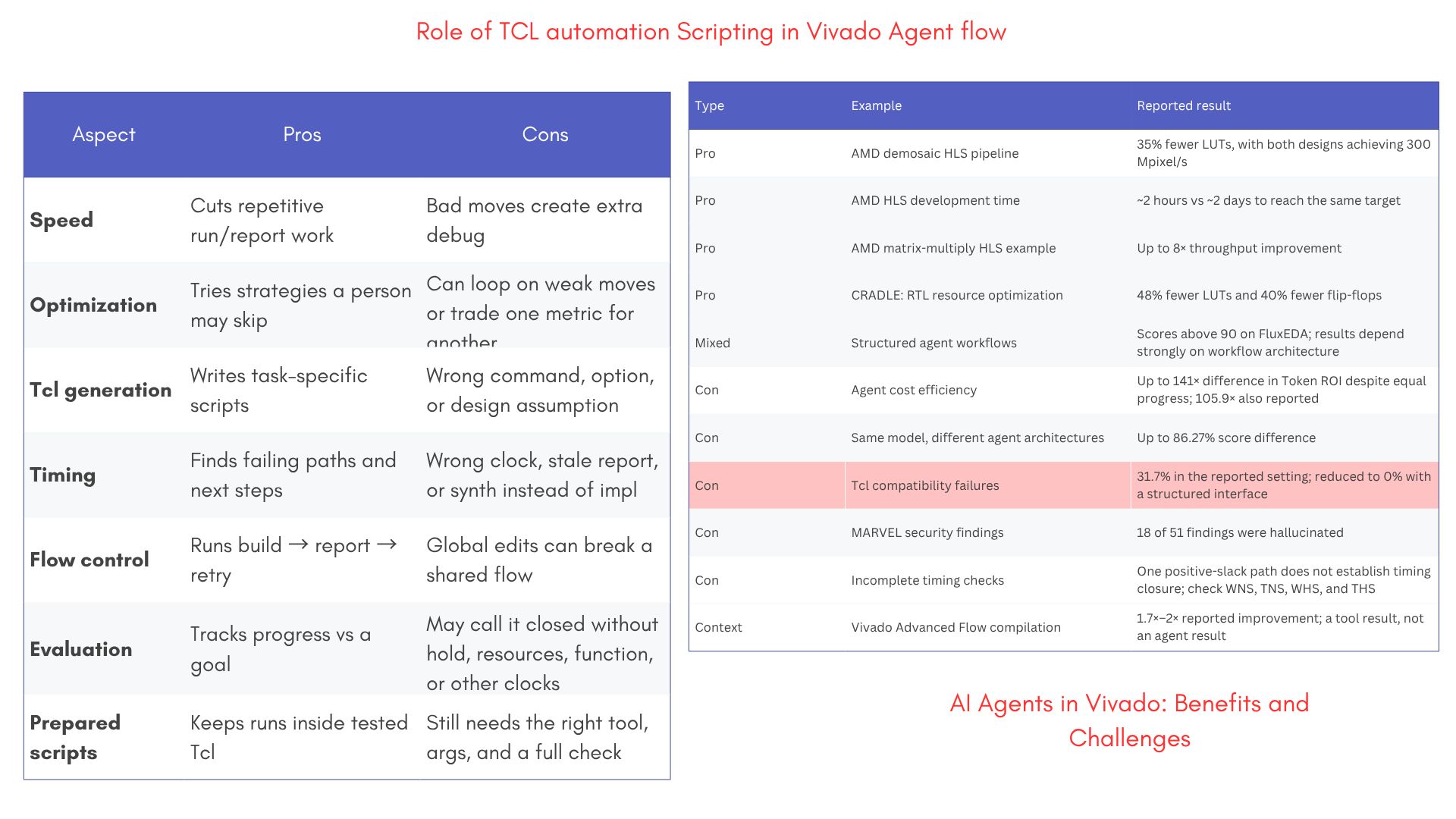
Agents can generate scripts that control the flow to meet our requirements, which could be as simple as achieving setup slack greater than 0 ns. They can run the design flow, generate timing reports, identify the worst paths, and try optimization strategies until they reach the specified goal or an attempt limit.
When we rely on agents to generate automation scripts for Vivado, much of this automation is written in Tcl. Suppose our design has multiple clocks, one for the core and another for peripherals. If we do not specify the intended clock, the agent may focus on peripheral timing instead of core timing.
Another difficulty is that generated scripts can interact with the entire design flow. We must ensure that agents modify only the parts we intend; otherwise, they may disrupt a flow maintained by another team member. For example, an agent might change the optimization strategy for the entire implementation run while trying to improve core timing. This could affect peripheral implementation results, causing a colleague to see changes in reports without changing their own code.
Other challenges include reading reports from a synthesized design instead of an implemented design and invoking incorrect or unsupported commands. More capable models may reduce these mistakes, but they do not eliminate them. Aggressive optimization may improve one part of the design while harming another. Agents may also overstate success by claiming that timing requirements have been met after checking only selected paths. They may repeatedly make unsuccessful attempts by trying similar optimization strategies.
Therefore, handing flow control and optimization to agents without clear boundaries can disrupt the team’s established workflow or lead to misleading claims of success.
Another approach is to use prepared scripts, which teams often already have. We can instruct agents to analyze reports, suggest the next step to address failures, and iterate through permitted optimization strategies using these scripts. Once we achieve the desired result, we can rerun the predefined verification and reporting flow to assess the effects on the complete design and decide the next step. With suitable checks and boundaries, this approach reduces the risk of disrupting the flow, missing resource or timing regressions, and overstating success while still allowing agents to explore optimization strategies.
Understanding Tcl automation and building a repeatable flow therefore provide an essential foundation before introducing agents into the Vivado workflow.