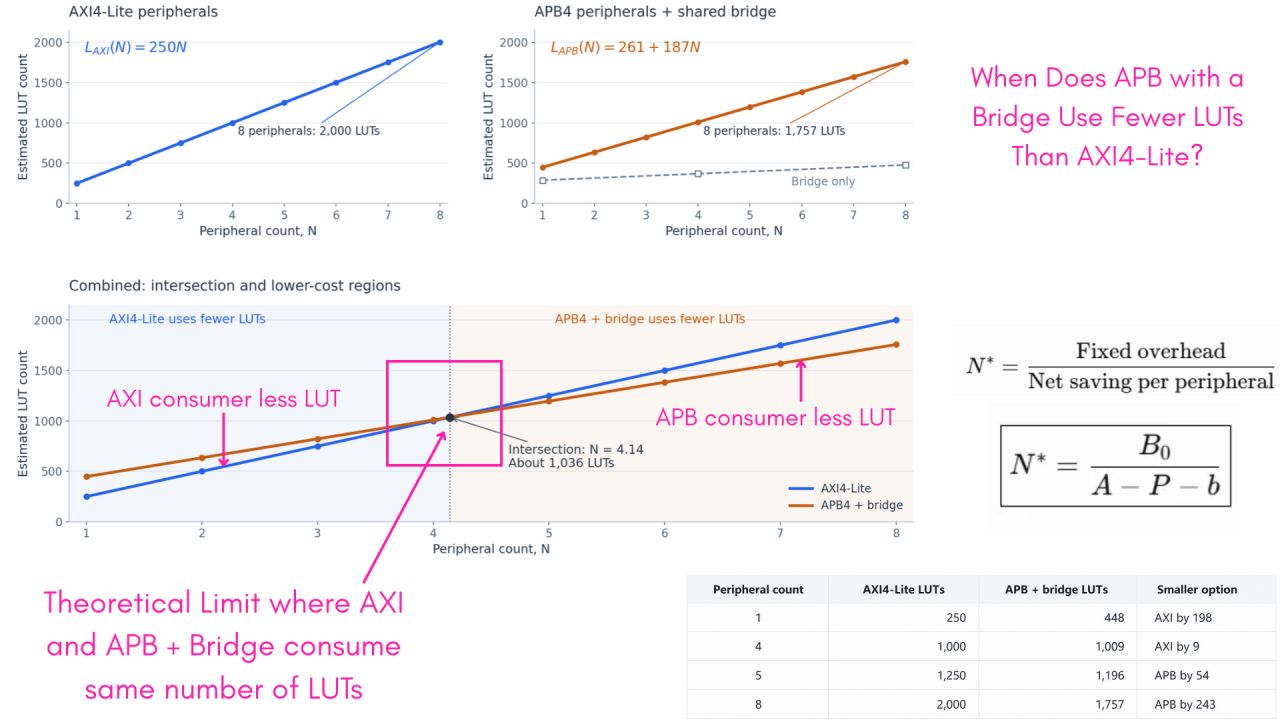
When Does APB with a Bridge Use Fewer LUTs Than AXI4-Lite?

Interfacing an APB peripheral with Zynq or MicroBlaze requires an AXI-to-APB bridge, which adds extra overhead due to axi2apb bridge compared to adding AXI4-Lite peripheral.
An interesting property of a shared bridge is that, as we add more and more peripherals, its overhead could actually be recovered through savings in the peripheral interfaces. At a certain peripheral count, APB with a bridge may consume the same or less number of LUTs as AXI4-Lite. Let us explore the peripheral count at which both consume the same amount of LUTs.
For this illustrative model, assume that interfacing a single AXI4-Lite peripheral with the processor consumes around 250 LUTs. This could be written as 250n, where n represents the number of peripherals.
AXI(n) = 250 * n
When we connect APB peripherals, assume that each peripheral costs around 160 LUTs, while the shared AXI-to-APB bridge has an approximate fixed cost of 261 LUTs and a variable cost of 27 LUTs per peripheral. This can be written as:
APB(n) = 160 * n + 261 + 27 * n = 261 + 187 * n
Each new peripheral increases the LUT count by 250 in the case of AXI4-Lite and 187 in the case of APB with a bridge. This means that, with every new APB peripheral, we save around 250 − 187, or 63 LUTs per peripheral.
The 261 LUTs represent the fixed bridge overhead, and with every peripheral we save around 63 LUTs. If we take the ratio of these two quantities, 261/63, we get around 4.14.
At this theoretical peripheral count, both AXI4-Lite and APB with a bridge consume the same number of LUTs. Since peripheral counts must be integers, adding five or more peripherals makes APB with a bridge consume fewer LUTs than AXI4-Lite under these assumptions.
The generalized expression for finding the peripheral count at which both consume the same number of LUTs is the ratio of the fixed bridge overhead to the net saving per peripheral.
Peripheral Threshold Count = Fixed Overhead / Net Saving
= Bridge_LUT_Fix / (AXI_LUT − APB_LUT − Bridge_extra_LUT)
If the net saving per peripheral is positive, APB resource consumption eventually becomes smaller than AXI4-Lite.
If the net saving is zero, both totals grow at the same rate, but APB retains the fixed bridge overhead, and the threshold formula is undefined.
If the net saving is negative, the APB LUT count grows faster than AXI4-Lite as we add more peripherals to the system.